For International Order Call On Whatsapp 203-332-7244 Need help? Call us: 203-332-7244 or info@emegatronic.com

DME buyer guide
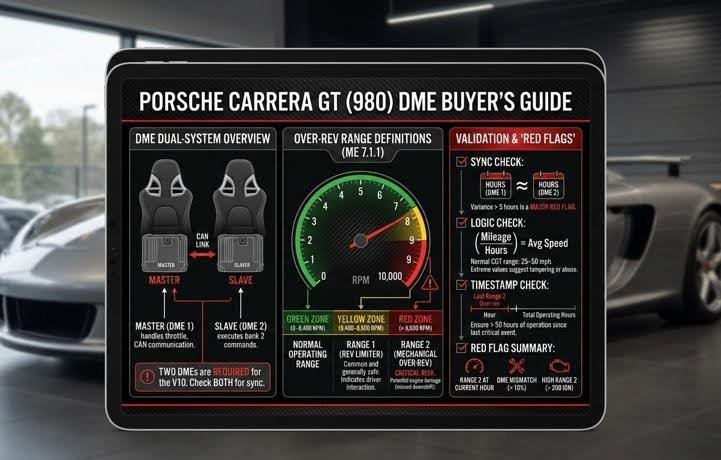
The Porsche Carrera GT uses two DME (Digital Motor Electronics) control units.
Unlike most standard Porsches that rely on a single engine control module, the Carrera GT’s 5.7L V10 engine utilizes a Master-Slave configuration to handle the processing power required for its ten cylinders.
Key Technical Details
- Model: Bosch Motronic ME 7.1.1
- Quantity: 2 (One unit manages each cylinder bank)
- Location: Both control units are located under the seats.
- Communication: The two units communicate with each other via a high-speed CAN (Controller Area Network) link at a rate of 500 kBaud.
Why two?
Porsche implemented this “dual-DME” setup because, at the time of the car’s development, a single control unit didn’t have enough driver stages or computing power to manage more than 8 cylinders with the precision Porsche required for a high-revving, race-derived V10.
When performing a diagnostic scan or pulling an “over-rev” report (DME report) on a Carrera GT, technicians must often check both units to get a complete picture of the engine’s history.
The Carrera GT’s V10 is a masterpiece of engineering, but its electronic “brain” setup is quite unique. Because it essentially treats the engine as two synchronized 5-cylinder blocks, the diagnostic data is split.
Carrera GT Over-Rev (DME) Ranges
When you pull a report for a Carrera GT, you’re looking for “ignitions” in specific ranges. Unlike modern Porsches that have six ranges, the Carrera GT (ME 7.1.1) uses only two ranges:
Range | Definition | Status |
|---|---|---|
Range 1 | 8,400 to 8,600 RPM | Reaching the factory rev limiter. Generally considered “safe.” |
Range 2 | Above 8,600 RPM | Mechanical over-rev (usually a missed downshift). Potential for engine damage. |
How the Master-Slave System Works
The two DMEs aren’t identical in their duties; they have a very specific hierarchy to ensure the V10 sings in perfect harmony:
- The Master (DME 1): This unit is the “boss.” It handles the overall engine torque demands, processes the accelerator pedal position, and communicates with the rest of the car’s systems (like the instrument cluster and traction control). It then tells the Slave unit what to do.
- The Slave (DME 2): This unit is dedicated to executing the commands for its specific bank of cylinders. It receives its “marching orders” from the Master via that high-speed CAN link.
- Synchronization: They must stay perfectly in sync. If the communication between the two lags or fails, the car will immediately enter “Limp Mode” to protect the engine from an imbalance in power delivery.
Pro Tip: If you are ever inspecting a CGT for purchase, ensure the technician provides the readout for both DME units. Since they record data independently for their respective banks, a discrepancy between the two can sometimes point to previous electrical or sensor issues.
When verifying the history of a high-value asset like a Carrera GT, the Total Operating Hours (often called “Operating Time”) is the most critical metric for spotting a “doctored” DME report or a replaced odometer.
The Authenticity Check
In a legitimate car, the engine hours should always correlate logically with the mileage on the odometer. Here is how you verify the data:
- The Calculation: Take the total mileage and divide it by the total operating hours.
- The “Sanity” Range: For a Carrera GT, the average speed is typically between 25 mph and 50 mph (40–80 km/h).
- Too Low (< 15 mph): Suggests excessive idling or a lot of time spent in heavy traffic.
- Too High (> 65 mph): Suggests the car was used almost exclusively on track or at high speeds—or that the odometer might have been rolled back.
Red Flags to Look For
Since the Carrera GT uses two DMEs, there are two specific ways to spot if something is “off”:
- DME Discrepancy: The operating hours on DME 1 (Master) and DME 2 (Slave) should be nearly identical. A difference of a few minutes is normal, but if one unit shows 200 hours and the other shows 450, it means one DME has been replaced or reflashed.
- The “Last Ignition” Timestamp: The DME report records the hour at which the last over-rev occurred. If the report says the last Range 2 over-rev happened at 350 hours, but the car currently only has 352 hours, that engine was “money-shifted” very recently—a massive red flag for a buyer.
- The Odometer Gap: If the odometer says 5,000 miles but the DME shows 500 hours, that’s an average of 10 mph. While possible, it’s more likely the odometer was tampered with or disconnected for a portion of the car’s life.
- The “Dual-DME” Sync Check
- Unit Count: You should have two separate printouts (one for Master, one for Slave).
- Operating Hours Match: The “Total Operating Time” on both units should be within 1–2% of each other.
- Red Flag: A difference of more than 5 hours suggests one unit was replaced or “cleared” independently.
- Range 1 & Range 2 Audit
- Range 1 (8,400–8,600 RPM): These are common. A high number of ignitions here just means the car was driven as intended and hit the rev limiter.
- [Range 2 (> 8,600 RPM): Ideally, this number is 0.
- Yellow Flag: A small number of ignitions (e.g., < 50) occurring hundreds of operating hours ago. This was likely a minor “blip” that didn’t cause damage.
- Red Flag: A high number of ignitions (e.g., > 200) or a Range 2 event that occurred within the last 50 operating hours.
- The “Average Speed” Math
Perform this quick calculation using the Master DME hours:
Odometer Mileage
Average speed = —————————–
Total Operating Hours
- Target: 25–50 mph.
- Logic Check: If the average speed is 12 mph, the car spent its life idling in a collection or in heavy traffic (not ideal for carbon buildup). If it’s 75 mph, it’s a track rat.
- Timestamp Validation
- Recency of Over-revs: Check the “Operating Time at last ignition” for both ranges.
- Goal: You want at least 50 hours of trouble-free operation since the last Range 2 event to ensure no delayed mechanical failures (like dropped valves) occurred.
- VIN & Firmware Verification
- VIN Match: Ensure the VIN displayed on the digital report matches the chassis plate.
- Software Version: Ensure both DMEs are running the same firmware version (e.g., 7.1.1).
Summary Table: What to Walk Away From
Issue | Severity | Why it matters |
|---|---|---|
Range 2 at Current Hour | Critical | The engine was likely just over-revved; damage may not be apparent yet. |
Hours Mismatch > 10% | High | High probability of “DME swapping” to hide high mileage or engine issues. |
Range 2 > 500 ignitions | High | Significant mechanical over-rev (missed shift). Risk of valve-to-piston contact. |