
Category: Auto Repair
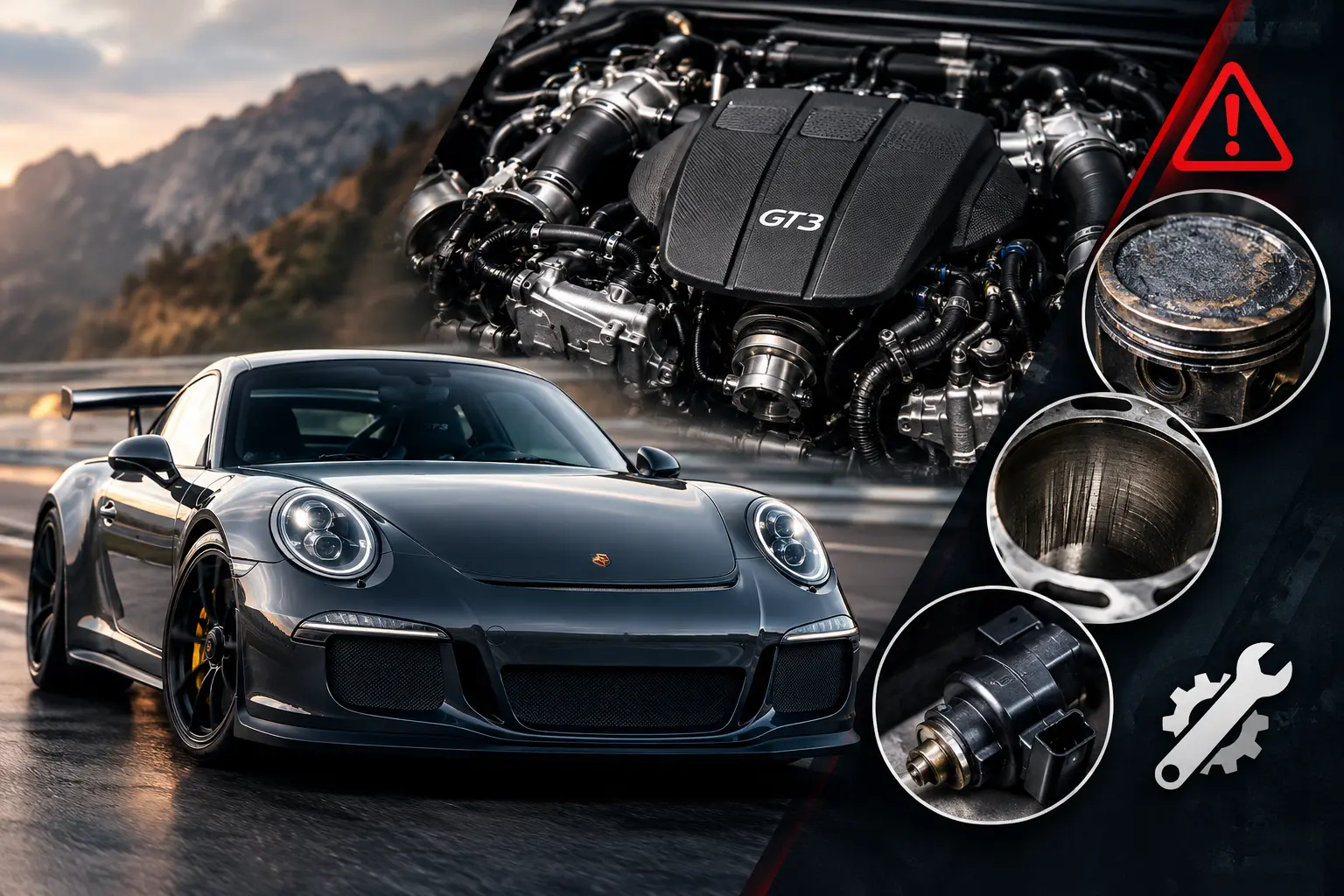
Most Porsche engine guides open with a design flaw. This one opens with a date. If your 991.1 GT3 went into service in 2014, your ten year engine warranty has already expired. If it went into service in 2015 or 2016, you are inside the final stretch. That single fact changes every decision you make about this car, because the MA175 is an engine Porsche replaced under warranty so often that some owners are on their third or fourth unit, and the safety net that made those replacements painless has a hard end date. This guide explains what the MA1.75 is, what the letter on your engine number means, what actually fails, how a workshop confirms it, and what your options look like once the warranty runs out. What MA175E actually means People write the engine code several ways. MA1.75, MA175, MA1/75. They all refer to the same engine. The letter that follows is where the useful information sits, and almost nobody explains it properly. Decoding the engine number Your engine number reads as the family code followed by a series letter and a five digit serial, in this format: MA175 E10997 So “MA175E” is not a separate engine model. It means you have an E-series MA1.75. That is a meaningful thing to know, and it is more useful than the model year on your registration document, because a large number of these cars are not running the engine they left the factory with. The E, F and G series explained Series Period What it represents E0 2013 to early 2014 Original factory engines. Every one was recalled and replaced. In principle none remain in service. E1 Mid 2014 onward Factory exchange engines built with revised connecting rod fastening, fitted to the recalled cars roughly four months after the stop-drive notice F 2015 Production engines with further detail improvements. Failures still occurred. G Late 2015 to 2016 Later production engines with the most developed valvetrain parts G6 2016 onward Replacement engine series supplied for warranty exchanges, generally considered the most durable 3.8 Two related codes cause confusion. MA1.76 (MA176) is the 4.0 litre engine in the 991.1 GT3 RS and the 911 R. MA2.75 and MA1.77 belong to the 991.2 generation. Porsche stated the finger follower issue was confined to the 991.1 GT3 and that the GT3 RS and 911 R were not affected. If you own an E-series engine, you own an early exchange unit. That places you in the group with the highest reported rate of subsequent valvetrain trouble, and it makes everything in Problem 2 below directly relevant to you rather than academic. Where to find your engine number Three places. There is a sticker on the underside of the rear engine lid, usually toward the right. There is a VIN sticker in the driver’s door shut that lists the engine number underneath the chassis number. And the number is engraved into the crankcase itself, ahead of the oil pump area below the crank pulley, which is the one that cannot be swapped or reprinted. Check the engraved number against the paperwork on any car you are buying. A dealer reading a number off a database is reading what the system was told, not necessarily what is bolted into the car. How the MA1.75 differs from every GT3 engine before it The 991.1 GT3 broke with tradition. Every GT3 before it used the Mezger engine, a design descended from the air-cooled 911 and the 962 race car. Porsche retired that architecture and built the 991.1 GT3 engine on the 9A1 family instead, in a heavily reworked GT specification sometimes labelled 9A1-M. No intermediate shaft at all The 9A1 design deletes the intermediate shaft. Chains drive the camshafts from the crankshaft directly. Every IMS discussion you have ever read about Boxster, Cayman and Carrera engines is irrelevant here, and so is every IMS retrofit product on the market. Dry sump and direct injection Oil lives in an external tank, with integrated pumps scavenging the crankcase and the heads. Fuel goes straight into the combustion chamber through direct injection rather than into the port. There is no dipstick. Oil level reads electronically through the instrument cluster, and it reads correctly only under the conditions Porsche specifies, meaning the engine is warm and running. Titanium rods and a 9,000 rpm ceiling The MA1.75 produces 475 hp at 8,250 rpm and spins to 9,000 rpm. It uses titanium connecting rods and forged pistons to get there. Those rods sit at the centre of the recall story below. The valvetrain that defines this engine To reach 9,000 rpm, Porsche moved away from bucket tappets and used finger followers, small rocker arms that sit between the cam lobe and the valve. The 991.1 version pairs those followers with hydraulic lash adjusters, so valve clearance sets itself and never needs manual adjustment. Andreas Preuninger’s team changed this for the 991.2, deleting the hydraulic adjusters entirely in favour of a rigid connection between follower and valve. That change came directly out of what the Cup car programme and the road cars revealed about the 3.8. Understanding that sequence tells you where to look on an MA1.75. Common Porsche GT3 MA1.75 engine problems and solutions The MA1.75 has a short list, but unlike the Mezger, the items on it are genuine design and manufacturing issues rather than wear outcomes. Here they are in the order they matter. Problem 1: Connecting rod bolt failure and the 2014 recall This is the event that defined the engine’s reputation, and it is also the one you are least likely to encounter today. What happened Two European GT3s suffered engine fires in early 2014. Porsche analysed them, issued a worldwide stop-drive advisory, and had dealers collect all 785 cars delivered to that point. The finding was specific. A connecting rod bolt worked loose, the loose connecting rod damaged the crankcase, oil escaped, and the escaping oil ignited against hot engine surfaces. Porsche’s remedy was not a repair. The company