
Porsche GT3 MA175 Engine Issues, Problems and Solutions (991.1 GT3, MA175 E, F and G Series)
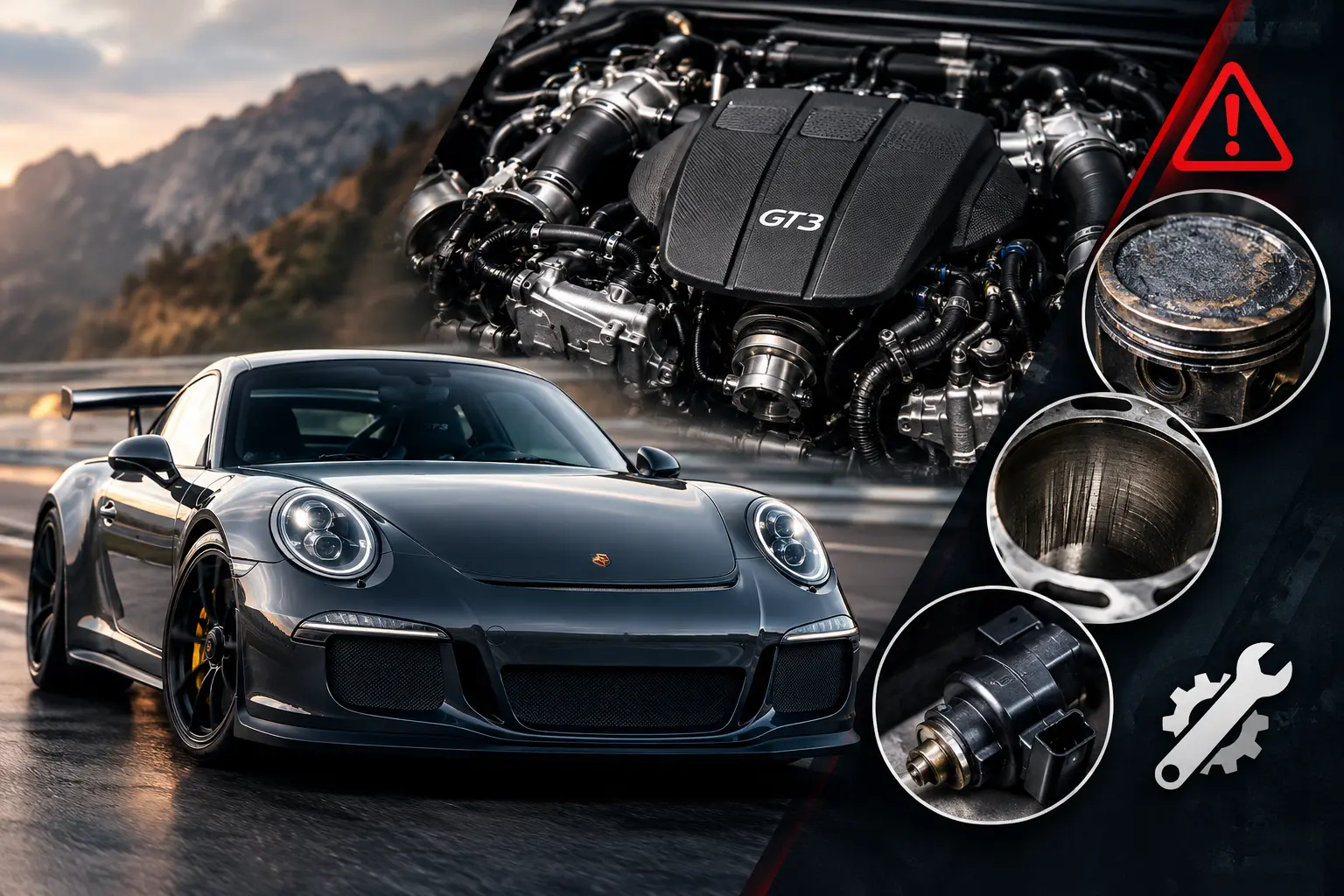
Most Porsche engine guides open with a design flaw. This one opens with a date.
If your 991.1 GT3 went into service in 2014, your ten year engine warranty has already expired. If it went into service in 2015 or 2016, you are inside the final stretch. That single fact changes every decision you make about this car, because the MA175 is an engine Porsche replaced under warranty so often that some owners are on their third or fourth unit, and the safety net that made those replacements painless has a hard end date.
This guide explains what the MA1.75 is, what the letter on your engine number means, what actually fails, how a workshop confirms it, and what your options look like once the warranty runs out.
What MA175E actually means
People write the engine code several ways. MA1.75, MA175, MA1/75. They all refer to the same engine. The letter that follows is where the useful information sits, and almost nobody explains it properly.
Decoding the engine number
Your engine number reads as the family code followed by a series letter and a five digit serial, in this format:
MA175 E10997
- MA175 identifies the engine family, the 3.8 litre GT-specification 9A1 flat six fitted to the 991.1 GT3
- E is the series letter, which tells you which revision of the engine you have
- 10997 is the individual serial number
So “MA175E” is not a separate engine model. It means you have an E-series MA1.75. That is a meaningful thing to know, and it is more useful than the model year on your registration document, because a large number of these cars are not running the engine they left the factory with.
The E, F and G series explained
| Series | Period | What it represents |
| E0 | 2013 to early 2014 | Original factory engines. Every one was recalled and replaced. In principle none remain in service. |
| E1 | Mid 2014 onward | Factory exchange engines built with revised connecting rod fastening, fitted to the recalled cars roughly four months after the stop-drive notice |
| F | 2015 | Production engines with further detail improvements. Failures still occurred. |
| G | Late 2015 to 2016 | Later production engines with the most developed valvetrain parts |
| G6 | 2016 onward | Replacement engine series supplied for warranty exchanges, generally considered the most durable 3.8 |
Two related codes cause confusion. MA1.76 (MA176) is the 4.0 litre engine in the 991.1 GT3 RS and the 911 R. MA2.75 and MA1.77 belong to the 991.2 generation. Porsche stated the finger follower issue was confined to the 991.1 GT3 and that the GT3 RS and 911 R were not affected.
If you own an E-series engine, you own an early exchange unit. That places you in the group with the highest reported rate of subsequent valvetrain trouble, and it makes everything in Problem 2 below directly relevant to you rather than academic.
Where to find your engine number
Three places. There is a sticker on the underside of the rear engine lid, usually toward the right. There is a VIN sticker in the driver’s door shut that lists the engine number underneath the chassis number. And the number is engraved into the crankcase itself, ahead of the oil pump area below the crank pulley, which is the one that cannot be swapped or reprinted.
Check the engraved number against the paperwork on any car you are buying. A dealer reading a number off a database is reading what the system was told, not necessarily what is bolted into the car.
How the MA1.75 differs from every GT3 engine before it
The 991.1 GT3 broke with tradition. Every GT3 before it used the Mezger engine, a design descended from the air-cooled 911 and the 962 race car. Porsche retired that architecture and built the 991.1 GT3 engine on the 9A1 family instead, in a heavily reworked GT specification sometimes labelled 9A1-M.
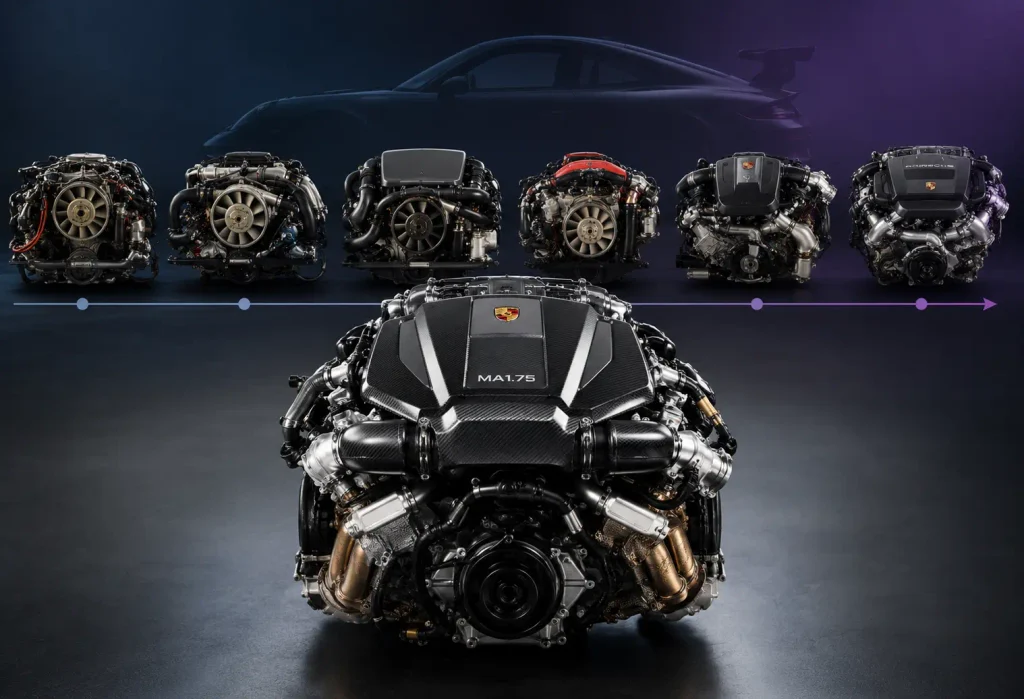
No intermediate shaft at all
The 9A1 design deletes the intermediate shaft. Chains drive the camshafts from the crankshaft directly. Every IMS discussion you have ever read about Boxster, Cayman and Carrera engines is irrelevant here, and so is every IMS retrofit product on the market.
Dry sump and direct injection
Oil lives in an external tank, with integrated pumps scavenging the crankcase and the heads. Fuel goes straight into the combustion chamber through direct injection rather than into the port. There is no dipstick. Oil level reads electronically through the instrument cluster, and it reads correctly only under the conditions Porsche specifies, meaning the engine is warm and running.
Titanium rods and a 9,000 rpm ceiling
The MA1.75 produces 475 hp at 8,250 rpm and spins to 9,000 rpm. It uses titanium connecting rods and forged pistons to get there. Those rods sit at the centre of the recall story below.
The valvetrain that defines this engine
To reach 9,000 rpm, Porsche moved away from bucket tappets and used finger followers, small rocker arms that sit between the cam lobe and the valve. The 991.1 version pairs those followers with hydraulic lash adjusters, so valve clearance sets itself and never needs manual adjustment.
Andreas Preuninger’s team changed this for the 991.2, deleting the hydraulic adjusters entirely in favour of a rigid connection between follower and valve. That change came directly out of what the Cup car programme and the road cars revealed about the 3.8. Understanding that sequence tells you where to look on an MA1.75.
Common Porsche GT3 MA1.75 engine problems and solutions
The MA1.75 has a short list, but unlike the Mezger, the items on it are genuine design and manufacturing issues rather than wear outcomes. Here they are in the order they matter.
Problem 1: Connecting rod bolt failure and the 2014 recall
This is the event that defined the engine’s reputation, and it is also the one you are least likely to encounter today.
What happened
Two European GT3s suffered engine fires in early 2014. Porsche analysed them, issued a worldwide stop-drive advisory, and had dealers collect all 785 cars delivered to that point. The finding was specific. A connecting rod bolt worked loose, the loose connecting rod damaged the crankcase, oil escaped, and the escaping oil ignited against hot engine surfaces.
Porsche’s remedy was not a repair. The company replaced the entire engine in every affected car with a unit built using revised connecting rod fastening. The service documentation also called for replacing the PDK vent line as part of the same quality initiative.
Why a bolt came loose
Porsche never published full detail. Independent specialists who studied the failures pointed at the torque tolerance on the rod fasteners, which was extremely narrow, and at the possibility that assembly tooling drifted out of calibration. Titanium rods and titanium rod caps complicate this further, because titanium and steel expand at different rates and a joint that relies on bolt stretch behaves differently as it heats.
There is a broader lesson worth understanding. Rod bolts are torque-to-yield fasteners. They stretch to hold clamp load, and once stretched they are single use. When clamp load falls below what the rod needs, the cap begins to move against the crank journal at several thousand cycles per minute, and the outcome is measured in seconds.
What this means for you today
If your car is a 2014 build, its original E0 engine is long gone. Your E1 exchange unit already carries the revised fastening. The recall is a closed chapter.
Verify it anyway. Ask a Porsche dealer to run your VIN for recall campaign completion, and check the engine number in the service file against the engraved number on the crankcase. Documentation of a recall completed is worth having when you sell.
Problem 2: Finger follower wear and cam lobe scoring
This is the issue that actually matters on an E-series engine, and it is the one that produced the extended warranty.
What a finger follower does
A finger follower is a small lever. The camshaft lobe presses on a roller or a pad on the top of the follower, one end of the follower pivots on a hydraulic lash adjuster, and the other end pushes the valve open. The arrangement lets the engine use lighter components than a bucket tappet system, which is how you get a road car to 9,000 rpm.
The contact surface between the cam lobe and the follower carries enormous load in a very small area. Porsche coats that surface with DLC, a diamond-like carbon film measured in microns. The coating is what makes the geometry survivable.
Why they fail
Three factors appear in nearly every teardown report.
- Coating wear. Once the DLC layer breaks through anywhere on the contact face, the substrate underneath is exposed and wear accelerates rapidly. Owners and specialists have linked some failures to metallurgical variation between production batches.
- High rpm operation. Wear concentrates in cars used above 8,000 rpm. That is not a criticism of the driver. It is what the car exists to do.
- Marginal lubrication. Reports repeatedly implicate oil supply to the valvetrain, with cylinder 6 appearing more often than the other five. Once the follower surface degrades, debris circulates and cam lobe scoring follows.
There is a counterintuitive pattern worth knowing. Some specialists report that gently driven cars fare no better, and possibly worse, than hard driven ones. The suspected reason is that low-rpm running does not deliver oil to the valvetrain as effectively, and short journeys never bring the oil up to temperature.
Symptoms
- A misfire that appears at high revs and not at idle, often with a check engine light
- A ticking or light tapping from the cam cover area
- Cylinder-specific misfire codes, with cylinder 6 over-represented
- Loss of power at the top of the rev range
- In advanced cases, metal debris appearing in the oil filter
Reported cases have surfaced from as low as 15,000 miles, which means mileage is a poor predictor on its own.
How it is diagnosed
Read the fault memory first
A high-rpm misfire on a specific cylinder is the classic signature. Print the freeze frame data, because the engine speed at which the misfire occurred is diagnostic in itself.
Remove the cam covers and inspect
This is the definitive test and there is no shortcut. A technician examines every follower contact face for DLC breakthrough and every cam lobe for scoring, pitting or a polished band where the coating has gone. On the MA1.75 this is a serious job and the engine usually comes out.
Inspect the oil
Cut the filter open and look at the media under good light. Follower and lobe material shows up as fine dark metallic debris. Send a sample for analysis as well, and watch chromium and iron in particular.
Check the oil supply
If the diagnosis confirms follower wear, the technician should also verify the oil feed path to the affected cylinder head rather than simply replacing parts. Fitting new followers into a head with a restricted oil supply buys you time, not a solution.
What Porsche did about it
Porsche initially replaced camshafts and finger followers on affected cars. That approach proved insufficient, partly because debris generated by the failure had already circulated through the lubrication system and into the bearings. Porsche moved to replacing complete engines with units built to the latest specification, which is where the G and G6 series come from.
What to do if you are outside warranty
This is now the real question for most owners, and it has three honest answers.
- Replace the engine with a later unit. Sourcing a G6 engine is the cleanest outcome and the most expensive. You end up with the most developed version of the 3.8.
- Rebuild the top end with current parts. A specialist replaces the camshafts, the followers and the lash adjusters with the latest part numbers, and inspects everything downstream for debris damage. Cheaper, and viable if you catch the wear before it contaminates the bottom end.
- Monitor and plan. If your car shows no symptoms, run short oil intervals, cut every filter open, send samples and keep a written baseline. You are buying information, and information is what lets you act before a follower failure becomes a bearing failure.
Problem 3: The warranty clock, and what happens when it stops
Porsche’s response to the finger follower situation was unusually generous, which makes its expiry unusually consequential.
What the warranty covered
Porsche extended coverage on the 991.1 GT3 engine to ten years from the original in-service date or 120,000 total vehicle miles, whichever came first. The extension is fully transferable to subsequent owners. The base new-car warranty terms did not change.
It began as coverage for failure modes related to the finger follower issue. Porsche later broadened it, telling owners that the limited warranty on all internal engine components would run for that same ten year and 120,000 mile period. That broader wording matters, because debris from a follower failure can damage bearings, and owners were finding their claims questioned when the presenting failure was not obviously a follower.
Why this is now the central issue
Ten years from in-service date means a car delivered in 2014 loses its coverage in 2024. Cars delivered in 2015 and 2016 are reaching the same point now. After that date, an engine failure that would once have been a phone call becomes a bill in the region of a used Cayman.
What to do about it
- Establish your exact in-service date. Not the model year, not the registration date on the logbook, the original in-service date on Porsche’s records. Ask a dealer to confirm it in writing.
- Find out which engine you are running. Read the engraved crankcase number. If it is a G or G6 you are in the best position available. If it is an E or an F, plan accordingly.
- Check the mileage side too. The 120,000 mile limit applies to total vehicle mileage, not engine mileage, so a car on its third engine still counts every mile it has covered.
- If you are still inside coverage, use it. Do not ignore a high-rpm misfire because the car still drives. Book the inspection while somebody else is paying for the outcome.
- If you are outside coverage, change how you maintain the car. Short oil intervals, filter inspection at every change and oil analysis on a schedule become genuinely important rather than merely virtuous.
Staff picks
-

204-6301 Porsche 986/987/996/997 M9 ARP Rod bolt kit
$194.43 -
Air-Cooled Resurrection Porsche 911 Turbo Engine Rebuild For Sale
Call For Estimate -
Emegatronic NOSE RING (EM-FCS60) | Porsche Air-Cooled Mezger Crankshaft Nose Seal Fix
$150.00 -
Genuine OEM Porsche Engine Block for M96/M97 (2000-2004) 3.2L
Price range: $7,500.00 through $8,500.00
Problem 4: Oil supply and the cylinder 6 pattern
The MA1.75 runs a dry sump, so the oil starvation failures that plague wet sump Porsche engines on track do not apply. The lubrication concerns here are different and more specific.
The cylinder 6 pattern
Cylinder 6 appears disproportionately in failure reports, in follower wear and in cam lobe scoring. The oil path to that cylinder head sits at the end of the supply route, which makes it the first to suffer if flow, pressure or oil condition falls below what the valvetrain needs.
You cannot redesign the oil gallery. You can control everything by feeding it.
Oil viscosity
Porsche specifies a particular grade and there is a long-running debate among owners about whether a heavier oil helps protect the valvetrain on E and F series engines. Some specialists have moved to a heavier grade on pre-G engines for exactly this reason.
Two cautions. Deviating from the specified grade can complicate a warranty claim while you are still covered. And oil choice is a mitigation, not a fix. A heavier oil may delay a failure mode caused by component metallurgy. It will not prevent it.
Discuss it with a Porsche specialist who works on these engines rather than acting on forum consensus.
Oil level
The electronic gauge reads correctly only with the engine warm and running. A cold reading tells you almost nothing, because much of the oil is still distributed through the engine rather than sitting in the tank. Owners who top up from a cold reading overfill the system, and an overfilled dry sump aerates its oil. Aerated oil compresses, and compressed oil does not carry load in a bearing or between a cam lobe and a follower.
Oil condition
Direct injection engines dilute their oil with fuel more readily than port injected engines, and short journeys where the oil never reaches full temperature let both fuel and moisture accumulate. Dilution thins the oil and reduces the film strength exactly where this engine is most sensitive. Change intervals based on time and use, not on what the maintenance reminder says.
Problem 5: Over-revs and bearing wear
What the DME records
The engine control unit logs excursions past the rev limit in six ranges ordered by severity, along with the number of ignition cycles since each event. A workshop with a Porsche PIWIS tester pulls the report in minutes.
Ranges 1 and 2 collect on any GT3 driven the way it was built to be driven. Range 3 deserves a look. Ranges 4 through 6 mean engine speed went beyond what the valvetrain can control.
The MA1.75 is PDK only, which changes the picture considerably. There is no clutch pedal and no money shift, so the catastrophic manual downshift over-rev cannot happen. What you can find instead is evidence of a mechanical over-rev, meaning the engine was driven beyond its limit by the wheels rather than by the throttle, which happens in a spin or an off. Range 4 or higher activity on a PDK car is therefore a strong signal about how the car has been used, and it is worth correlating against any bodywork or underside repair history.
How to interpret the report
Convert ignitions since the event into a rough date by estimating how often the car gets started. Then line that date up against the service file. A severe event followed by an engine-out visit tells one story. A severe event with nothing after it tells another.
Follow the report with a leakdown test on all six cylinders. You are looking for one cylinder behaving differently from the other five.
Bearing wear
Debris is the main threat to bearings in this engine, and the usual source is the valvetrain. A follower that sheds coating and then substrates material puts hard particles into circulating oil, and those particles embed in bearing surfaces. This is precisely why Porsche stopped repairing cam and follower damage in isolation.
Monitor it through oil analysis. Copper, lead and tin rising across three consecutive changes means bearing material is entering the oil. A single elevated result means nothing. A trend means plan.
Cut the filter open every time. Standard spectrographic analysis measures particles below a size threshold, and the larger debris that matters most passes straight through the reporting range without appearing on the report.
Problem 6: Direct injection carbon deposits
The MA1.75 injects fuel directly into the cylinder, which means no fuel washes across the back of the intake valves. Oil vapour from the crankcase ventilation system reaches those valves, bakes onto them and builds up over time.
Symptoms
Deposits accumulate slowly and the car adapts around them, so drivers rarely notice a specific day when something changed. Look for a rough cold idle, a slight hesitation off throttle, reduced top end pull and, in advanced cases, misfire codes.
How it is confirmed
A borescope through the intake port shows the valve backs directly. There is no other reliable test, and there is no point guessing when a camera settles it.
The fix
Walnut shell blasting is the standard remedy. A technician removes the intake manifold, seals each port and blasts the deposits off with crushed walnut media, then vacuums the residue out. Chemical treatments poured into the fuel tank cannot reach the intake valves on a direct injection engine, whatever the bottle claims.
Prevention
Keep the crankcase ventilation system healthy, use quality fuel and avoid a diet of short cold journeys. None of this eliminates deposits. It slows them.
Problem 7: Cooling system and peripherals
These items are less dramatic and more likely to actually affect you in a given year.
Water pump
The impeller can shed material as the pump ages. A failed pump causes overheating, and overheating threatens an aluminium engine. Most specialists replace it preventatively rather than waiting.
Coolant lines and connections
The 991 runs a long, complex cooling circuit with radiators at the front and the engine at the rear. Plastic connectors and line ends become brittle with age and heat cycling. Pressure test the system at service rather than relying on the level warning.
Central oil separator
The crankcase ventilation system separates oil from blowby gases and returns it. When it fails, you get smoke on start-up or trailing throttle, rising oil consumption and a fuel trim shift. A crankcase pressure test distinguishes a separator fault from ring wear, and it takes a competent shop under an hour.
Coil packs and plugs. A misfire on a GT3 is more often ignition than mechanical. Rule out coils and plugs before anyone opens a cam cover. That said, a high-rpm misfire on a specific cylinder that survives new coils and plugs takes you straight back to Problem 2.
Engine and transmission mounts. Collapsed mounts transmit vibration and clunks that owners interpret as internal noise.
Inside an MA1.75 engine: what a specialist inspects
This section is a teardown checklist rather than a failure list. These components do not routinely fail on a road-driven 991.1 GT3. They get measured and judged when the engine is already apart, and knowing what a builder examines tells you whether a quote is thorough or superficial.
Camshafts and finger followers
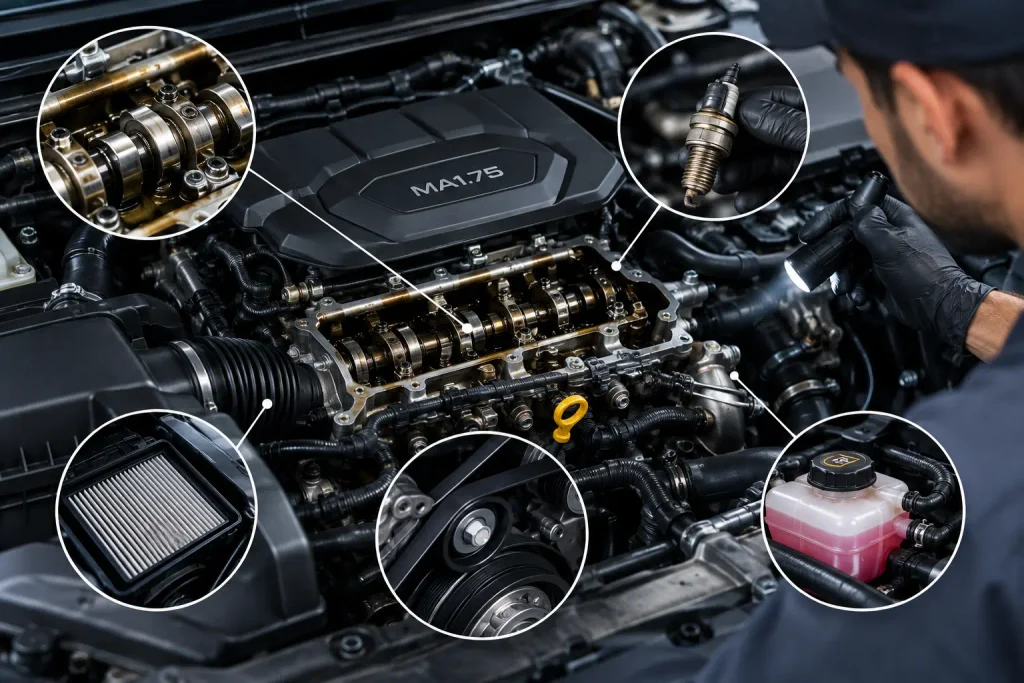
The first place anybody looks at this engine. Every follower contact face gets inspected for DLC breakthrough, and every cam lobe gets checked for scoring, pitting, polished bands and measurable lobe height loss. Hydraulic lash adjusters get checked for collapse and for their ability to hold pressure. Any follower showing wear means all of them get replaced, because they share the same oil, the same heat and the same hours.
Connecting rods and rod bolts
Titanium rods get checked for straightness and big end bore roundness. A rod that has run a marginal bearing distorts its big end, and a distorted big end destroys the next bearing too.
Rod bolts are replaced without exception. They are torque-to-yield fasteners, they are single use by design, and the entire 2014 recall traces back to clamp load in this joint. A rebuild quote that does not list new rod bolts is a quote to walk away from. Torque procedure matters as much as the parts, because these joints have a narrow tolerance and an angle-torque sequence, not a simple figure on a wrench.
Crankshaft
Magnetic particle inspection for cracks, concentrating on the fillet radii where journals meet webs. Each journal is measured with a micrometer for diameter, taper and out-of-round. Runout checked between centres, because a crank can bend without breaking. Thrust surfaces inspected for endplay. Light scoring polishes out. Deep gouges and heat discolouration do not.
Main and rod bearings
Bearings get read rather than just replaced. Uniform grey wear is normal ageing. Copper showing through means the overlay is gone. Scratching means debris was in the oil, which sends the builder looking upstream, usually toward the valvetrain. Wear on one side points at a bent rod or a misaligned journal.
Pistons and rings
Crowns inspected for detonation erosion and valve contact marks. Skirts measured perpendicular to the wrist pin axis for collapse. Ring grooves are measured with feeler gauges for vertical play, because worn grooves let rings flutter and no new ring fixes that. New rings gapped to the finished bore rather than fitted from the box. Circlips are always replaced.
Cylinder bores
The 9A1 crankcase does not use the individually replaceable liners the Mezger had, so bore condition is a more consequential finding here. Each bore gets measured for diameter, taper and ovality against factory tolerance, and inspected for scoring. Any block that has been through a debris event, an overheat or a rod failure needs measuring rather than assuming.
Cylinder heads
Valve stem to guide clearance measured directly. Installed spring height and seat pressure checked on a tester. Seats inspected for recession. Dye penetrant inspection for cracks between seats and around the plug boss. Flatness checked on a surface plate if the engine has ever overheated.
A realistic maintenance plan
| Item | Interval | Why |
| Oil and filter | Annually, or every 5,000 miles, or after every two track weekends | Fuel dilution from direct injection and moisture load the oil regardless of mileage |
| Cut the filter open | Every change | Valvetrain debris is the earliest warning you get, and analysis misses larger particles |
| Used oil analysis | Every change | Trend matters more than any single result |
| Read oil level correctly | Every check | Warm and running only, or the reading misleads you into overfilling |
| Scan for fault codes | Every service | A stored high-rpm misfire is the finger follower signature |
| Over-rev report | At every major service and before any sale | Free diagnostic, permanently stored |
| Borescope intake valves | Around 40,000 miles | The only way to see carbon deposits |
| Water pump and coolant lines | Preventatively, and pressure test at service | Overheating threatens an aluminium engine |
| Spark plugs and coils | Per Porsche interval, sooner with track use | Ignition faults masquerade as mechanical faults |
| Compression and leakdown | Every two to three years on tracked cars | Establishes a baseline you can compare against later |
| Confirm warranty status | Once, in writing | Determines your entire maintenance strategy |
What to check before you buy a 991.1 GT3
- Read the engraved engine number on the crankcase, not the paperwork. E, F, G or G6 changes what you are buying.
- Establish the original in-service date and calculate exactly how much engine warranty remains, if any.
- Confirm total vehicle mileage against the 120,000 mile limit, remembering it counts vehicle miles rather than engine miles.
- Ask how many engines the car has had and get the replacements documented. Several is common and not automatically a red flag, but you want the current unit identified.
- Pull the fault memory and the over-rev report. A stored high-rpm misfire on a specific cylinder is the single most important finding available.
- Run a leakdown on all six cylinders and look for consistency rather than a target number.
- Cut the oil filter open if the seller will allow it, or arrange a fresh oil change as part of the inspection.
- Verify recall campaign completion by VIN through a Porsche dealer.
- Listen to a genuine cold start. Ask the seller not to warm the car up before you arrive.
- Inspect the underside for kerb strikes, skid plate damage and repaired panels, which tell you about the car’s life beyond what any report shows.
The honest summary
The MA1.75 is a brilliant engine with a genuinely troubled service history, and pretending otherwise helps nobody. Porsche built a road car that revs to 9,000 rpm and then spent three years working out which parts of it could survive that. The company’s response, replacing engines wholesale and extending coverage to ten years and 120,000 miles, was the right one and it protected a lot of owners.
That protection is ending. From here, an MA1.75 owner is managing the engine on their own terms.
Find out which series engine you have. Confirm your warranty position in writing. Treat any high-rpm misfire as urgent rather than annoying. Change the oil on a calendar and cut every filter open. Read the oil level the way Porsche tells you to.
These cars are worth owning. They just stopped being cars you can own passively.
Frequently asked questions
What does MA175E mean on my engine number?
MA175 is the engine family, the 3.8 litre GT engine fitted to the 991.1 GT3. E is the series letter identifying the revision. An E-series engine is an early unit, most commonly an E1 exchange engine fitted after the 2014 recall.
Is the MA1.75 the same as the Mezger engine in the 997 GT3?
No. Porsche retired the Mezger after the 997. The MA1.75 belongs to the 9A1 family, uses direct injection, deletes the intermediate shaft entirely and drives its valves through finger followers. The two engines share a layout and very little else.
Does the 991.1 GT3 have an IMS bearing problem?
No. The 9A1 architecture has no intermediate shaft.
Which MA1.75 engine series should I look for?
G6 units, supplied as replacement engines from 2016 onward, carry the most developed parts. G-series production engines come next. E and F series engines have the highest reported rate of valvetrain trouble.
How long does the 991.1 GT3 engine warranty last?
Ten years from the original in-service date or 120,000 total vehicle miles, whichever comes first. It transfers to subsequent owners. Cars delivered in 2014 have already passed the time limit.
Are the 991.1 GT3 RS and 911 R affected?
Porsche stated the finger follower issue was confined to the 991.1 GT3 and that the GT3 RS and 911 R were not affected. Those cars use the 4.0 litre MA1.76. Separate failures have been reported on individual RS cars, as happens with any high-output engine, but they are not part of the same campaign.
Can a finger follower problem be repaired without replacing the engine?
Sometimes. If the wear is caught before debris circulates, a specialist can replace camshafts, followers and lash adjusters and inspect downstream components. Once debris has reached the bearings, the economics usually favour a complete engine.Porsche GT3 MA1.75 Engine Issues, Problems and Solutions (991.1 GT3, MA175 E, F and G Series)