
Porsche GT3 M97 Engine Issues, Problems and Solutions (997 GT3, GT3 RS and RS 4.0)

Search the 997 GT3 forums long enough and you will meet two kinds of owner. The first bought the car, read every M96 horror story ever written, and now changes the oil every 2,000 miles waiting for an intermediate shaft bearing that his engine does not have. The second bought the car, tracked it for six years, and lost a weekend when a coolant pipe let go on the out lap at Road Atlanta.
Only one of those owners was worrying about the right thing.
This guide covers what actually breaks on the Mezger flat six fitted to the 997 GT3 and GT3 RS, why it breaks, how to catch it before it costs you an engine, and what the fix involves. It also covers what a builder finds when one of these engines finally comes apart, because rebuild questions and failure questions are two different conversations and most articles blur them together.
First, get the engine code right
A lot of bad information circulates because people treat “M97” as one engine. It is not. Porsche used the M97 designation across two completely unrelated engine families.
| Model | Engine code | Displacement | Family |
| 997.1 GT3 and GT3 RS (2007-2009) | M97.76 | 3.6L | Mezger |
| 997.2 GT3 (2010-2011) | M97.77 | 3.8L | Mezger |
| 997.2 GT3 RS (2010-2011) | M97.77R | 3.8L | Mezger |
| 997 GT3 RS 4.0 (2011-2012) | M97.74 | 4.0L | Mezger |
| 997 Turbo (2007-2009) | M97.70 | 3.6L | Mezger |
| 997 GT2 / GT2 RS | M97.70S / M97.70 | 3.6L | Mezger |
| 997.1 Carrera S (2005-2008) | M97.01 | 3.8L | M96 family |
| 987 Cayman S / Boxster S | M97.21 / M97.22 | 3.4L | M96 family |
The last two rows matter enormously. The M97.01 and M97.21 are direct descendants of the M96 that powers the base Carrera and Boxster. They use Lokasil cylinder bores, a wet sump Porsche marketed as an “integrated dry sump,” and an intermediate shaft riding on a sealed ball bearing. They suffer bore scoring and IMS failures.
The GT3 engine shares almost nothing with them. Different crankcase, different oiling architecture, different cylinder technology, different intermediate shaft bearing design. If an article about your GT3 starts talking about IMS retrofits and Lokasil pre-forms, close the tab.
You will also see “M97/50” floating around parts listings and keyword tools. No such Porsche engine exists. It is almost certainly a garbled M97.70 or a transposed M97.01.
Why the Mezger is built differently
Hans Mezger designed the architecture underneath this engine for the 911 racing programme, and Porsche carried it through the 956, the 962 and the 911 GT1. The 996 and 997 GT3 inherit that casting.
Three design decisions define how the engine ages.
Split crankcase
The case parts on the crankshaft centreline, the same way the air-cooled 911 case does. Main bearings sit in saddles machined into the case halves. On the Carrera M96 and M97, the crankshaft rides in a separate three-piece carrier assembly. The Mezger layout is stiffer and, more usefully for you, it can be opened and rebuilt by any competent Porsche engine builder using factory service specifications.
True dry sump
Oil lives in an external tank, not in the bottom of the engine. A multi-stage pump scavenges oil from the crankcase and the heads and feeds it back through the tank. Sustained lateral load does not uncover the pickup. This is the single biggest reason GT3s survive track use that destroys Carrera engines, and it is why the oil starvation countermeasures sold for M96 cars, deep sumps, baffles and accumulators, are irrelevant here.
Replaceable cylinder liners with Nikasil bores
Each cylinder is an individual liner coated in a nickel silicon carbide matrix. Nikasil is a plated coating, genuinely hard, and it does not rely on exposed silicon particles the way Lokasil and Alusil do. Bore scoring, the failure that writes off Carrera blocks, does not affect these engines as a population. When a Mezger liner does get damaged, a builder replaces that liner. On an M96 crankcase, the equivalent damage means sleeving the whole block or sourcing another case.
The 997.1 GT3 also drops VarioCam Plus. Porsche kept variable intake cam timing but deleted the switchable lift mechanism, because the two-stage hardware was too heavy to let the engine reach 8,400 rpm reliably.
Common Porsche GT3 M97 engine problems and solutions
None of this makes the engine immortal. It makes the failure list short and specific. Six items account for almost everything that goes wrong on a road-driven or club-tracked 997 GT3.
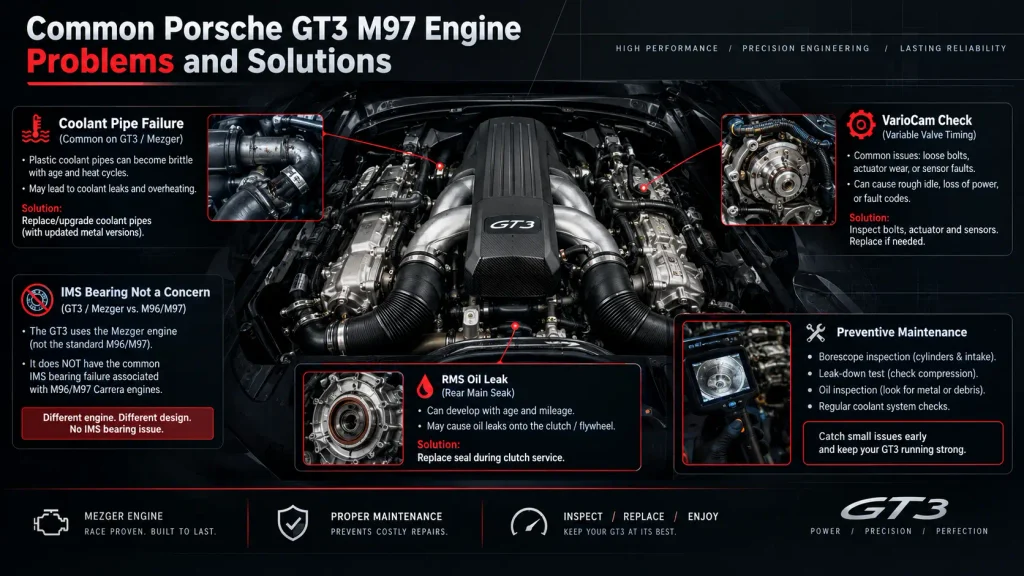
Problem 1: Coolant pipe separation
This is the headline fault, and it is the only one that can strand a healthy engine without warning.
What happens
Coolant travels from the pump through a set of tubes that run inside the V of the engine to feed the water jackets around each bank. Porsche assembled some of those tube joints with structural adhesive rather than welding them. Heat cycling, vibration and twenty years of glycol exposure break the bond down. The joint walks apart, the cooling system dumps its contents in seconds, and you are looking at a temperature gauge climbing while steam fills the mirrors.
Why it matters more than the leak itself
The coolant loss is cheap. The consequence is not. An aluminium flat six that loses coolant at 7,000 rpm can distort a head, cook a head gasket or nip a piston before the driver reacts. On track the gearbox and tyres behind you get coated as well, which is how single-car offs become multi-car incidents.
Symptoms and detection
You often get no warning at all, which is why owners treat this as scheduled work rather than a repair. When there is a warning, it shows up as:
- Coolant level dropping slowly with no visible external leak
- A sweet glycol smell after a hard session that fades once the car cools
- Dried pink or orange crust around the pipe joints, visible only with the engine lowered or with a borescope through the rear of the engine bay
- A pressure test that holds at rest but bleeds down once the system reaches operating temperature
The solution
Shops pin and TIG weld the joints. A technician drills through the outer tube into the insert, fits a locating pin, then welds the seam so the joint becomes mechanical instead of chemical. Porsche Motorsport did this on the Cup cars from the start.
The work requires the engine to come out, which is why you should never do it alone. Bundle it with the clutch, rear main seal, air oil separator, motor mounts, water pump and thermostat. The labour overlaps almost completely, and you turn three separate engine-out visits into one. Budget roughly 12 to 16 hours of shop time for the pipe work itself and plan the rest around it.
If you are shopping for a 997 GT3, welded pipes in the service file are worth real money. Unwelded pipes on a car you intend to track means you are buying a job, not a question mark.
Problem 2: Over-revs and the money shift
The Mezger bottom end tolerates 8,400 rpm all day. It does not tolerate 9,800 rpm for a quarter of a second, and that is what happens when a driver selects second instead of fourth at the end of a straight.
What the DME records
The engine control unit logs every excursion past the redline in six ranges, ordered by severity. It also records how many ignition cycles have passed since each event. Any workshop with a Porsche PIWIS tester, and most independents with a capable scan tool, can pull the report in minutes.
Read the report like this:
- Ranges 1 and 2 accumulate on any car driven with intent. Downshifts, cold engine rev limiter hits, the odd enthusiastic upshift. These are noise.
- Range 3 deserves a second look, especially in volume on a low-mileage car.
- Ranges 4, 5 and 6 mean the valvetrain went somewhere it was never designed to go. Valve float, spring surge, and at the top end, valve-to-piston contact.
The ignition cycle counter tells you whether the event was recent. A range 6 hit logged 40,000 ignitions ago on a car that has run faultlessly since is a different conversation from one logged last weekend.
How an over-rev is diagnosed
Pulling the report is the easy half. Interpreting it takes a sequence.
Step one: read the raw counts
Note the number of events in each range and the ignition-on count since the last event in each range. Photograph the screen. Sellers have been known to describe a report from memory in generous terms.
Step two: work out when it happened
Divide the ignitions since the event by how many times the car realistically gets started per week. A car started twice a week has logged roughly 100 ignitions a year. This converts an abstract number into a rough date, and that date usually lines up with something in the service file or the previous owner’s track history.
Step three: correlate with service records
A range 5 or 6 event followed shortly by a clutch replacement, a gearbox rebuild or an unexplained engine-out visit tells you the money shift happened and somebody dealt with the aftermath. A severe event with nothing after it in the file means the consequences, if any, are still inside the engine.
Step four: test the cylinders
Leakdown on all six is the physical confirmation. You are looking for one cylinder that behaves differently from the other five. Listen at the intake, at the exhaust and at the oil filler while the cylinder is pressurised. Air escaping from the intake means an intake valve is not sealing. Air from the exhaust points at an exhaust valve. Air from the oil filler points at rings, which over-revs do not usually damage.
Step five: borescope if the numbers disagree
A camera through the plug hole shows valve face condition and piston crown witness marks. Contact between a valve and a piston leaves a visible impression on the crown, and that impression settles the question permanently.
A clean report with no range 4 activity and consistent leakdown across six cylinders is one of the strongest signals available on a used GT3. It is worth paying for the inspection even if the car looks perfect.
Why the damage is not always immediate
A severe over-rev can bend a valve stem slightly, take the edge off a valve seat, or set a spring without the engine ever running badly. The car drives home. Compression falls off on one cylinder over the following months, the owner blames age, and the real cause sits in a log file nobody pulled.
Prevention
Fit a shift light if your eyes live on the road instead of the tacho, and rev-match deliberately rather than dumping the clutch on downshifts. The engine survives high rpm. It does not survive being driven backwards through its own gearing.
Problem 3: Air oil separator failure
The AOS handles crankcase ventilation. It pulls blowby gases out of the crankcase, separates suspended oil droplets from them, drains the oil back and routes the cleaned vapour into the intake to be burned.
How it fails
The internal diaphragm splits or the separator chamber clogs. Once that happens, manifold vacuum reaches straight into the crankcase and starts pulling liquid oil rather than vapour into the intake tract.
Symptoms
- Thick white or blue smoke at start-up or on a trailing throttle, sometimes dramatic enough that bystanders assume the engine has grenaded
- Oil consumption climbing for no apparent reason
- Rough idle and a fuel trim shift, because the vacuum leak upsets the metered air calculation
- Oil residue inside the intake tubing and around the throttle body
How to tell an AOS fault apart from internal engine wear
Both conditions burn oil and both produce smoke, which is why owners panic. The two behave differently under specific conditions, and a methodical shop separates them in under an hour.
Read the smoke
AOS smoke arrives in clouds. It appears at cold start after the car has sat, or on a long trailing throttle down a hill, then clears once the engine works again. Worn rings or guides produce a steadier, thinner haze that tracks engine load rather than appearing in sudden bursts.
Run the crankcase pressure test
This is the decisive one. A shop fits a manometer or a low-range gauge to the oil filler and reads crankcase pressure at warm idle. Strong vacuum means the AOS diaphragm has failed and the crankcase is being pulled on directly. Positive pressure means gas is getting past the rings faster than the breather can clear it, which points at the bottom end. A healthy engine sits in a narrow band between the two, and any competent Porsche shop knows the target for these engines.
Do a leakdown, not just a compression test
Compression tells you a number. Leakdown tells you where the air goes. Air escaping at the oil filler means rings. Air at the intake or exhaust means valves. If leakdown is clean across all six cylinders and you are still burning oil, the bottom end is not your problem.
Check the intake tract
Pull the intake tubing and look. AOS failure leaves standing oil and wet residue upstream of the throttle body, because liquid oil is being drawn through the breather hose. Ring wear does not put oil there. It puts it on the combustion side.
Look at the plugs
Worn valve guides foul one or two plugs on the affected cylinders while the rest stay clean. AOS failure tends to affect cylinders more evenly, because the oil enters through the shared intake.
Send an oil sample
Elevated copper, lead and tin point at bearings. Elevated iron and chrome point at rings and liners. A clean wear-metal report alongside heavy oil consumption effectively rules the bottom end out and leaves the AOS as the answer.
The fix and the hidden risk
Replacement is straightforward and the part is not expensive by GT3 standards. The risk is ignoring it. A failed AOS can hydraulically lock a cylinder if enough liquid oil collects on top of a piston while the engine sits, and a hydrolocked engine bends a connecting rod. That turns a modest part into a bottom-end rebuild.
Treat the AOS as a wear item. Replace it while the engine is out for coolant pipe work rather than waiting for the smoke.
Bestsellers
-

204-6301 Porsche 986/987/996/997 M9 ARP Rod bolt kit
$194.43 -
Air-Cooled Resurrection Porsche 911 Turbo Engine Rebuild For Sale
Call For Estimate -
Emegatronic NOSE RING (EM-FCS60) | Porsche Air-Cooled Mezger Crankshaft Nose Seal Fix
$150.00 -
Genuine OEM Porsche Engine Block for M96/M97 (2000-2004) 3.2L
Price range: $7,500.00 through $8,500.00 -

Isotropic Superfinishing (ISF) for Porsche Crankshafts | EM-ISOTROPIC
$1,200.00 -
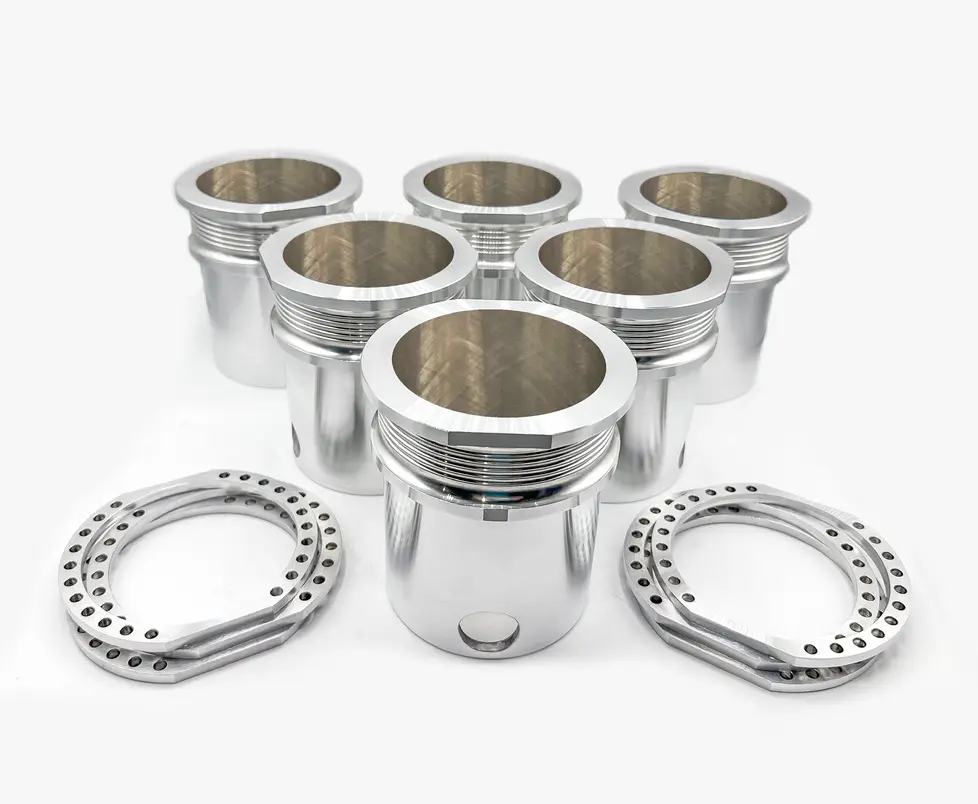
M96/M97 3.6L to 3.9L Nikasil Liner Conversion | Closed-Deck 100mm Bore
Price range: $2,700.00 through $4,100.00
Problem 4: Valvetrain, Valve Guide and Valve Seat Wear
This is a wear issue rather than a design defect, and the distinction matters when you read forum posts.
The GT3 uses forged connecting rods, aggressive cam timing and a high compression ratio. Exhaust valves in a naturally aspirated engine held above 6,500 rpm for twenty-minute sessions run extremely hot. Cars with hundreds of track hours develop three related conditions.
- Seat recession. The valve gradually sinks into its seat as both surfaces wear. Valve clearance closes up, and in the worst case the valve stops seating fully, loses its heat path into the head, and starts to burn.
- Guide wear. The guide controls how squarely the valve meets the seat. A worn guide lets the valve wander, which accelerates seat wear and lets oil past the stem seal into the chamber.
- Spring fatigue. Springs lose installed height and seat pressure after enough hours near the redline. Weak springs allow valve float, which is the same mechanism a severe over-rev triggers, just arrived at slowly.
Symptoms
- Valve clearance drifting out of specification at inspection
- Compression or leakdown falling on one cylinder while the others stay healthy
- A misfire code that only appears under sustained load, not at idle
- Light oil consumption with no external leak and a healthy AOS
- Blue smoke on a trailing throttle after a long downhill section, which is classic guide and stem seal behaviour
Detection
Compression and leakdown testing catches it. Do not rely on the absence of a check engine light, because seat recession develops slowly and the DME will not flag it until combustion quality actually degrades.
A builder assessing a head measures valve stem to guide clearance directly, checks installed spring height and tests seat pressure on a spring tester. Cracks between the valve seats and around the spark plug boss get found with dye penetrant inspection, and any head that has been through an overheat gets checked for flatness on a surface plate.
Prevention
Cool-down laps matter more than most drivers think. Exhaust valves shed heat through the seat, and the transfer only happens while the valve is closed against it. Bringing a GT3 straight off a hot lap into the paddock and shutting it down leaves those valves soaking. Run a cool-down lap, then let the engine idle for a minute or two before you switch off.
Oil choice matters too. Porsche specifies a heavy grade for these engines, and track use at 250°F or higher oil temperature is precisely the condition that grade exists for. Resist the urge to run a thinner oil for the fractional power gain.
Resolution, when it comes, is a head service or a head rebuild. Expect four figures in the middle of that range, and expect the engine to come out.
Problem 5: Bearing wear at high track hours
A GT3 that has accumulated 80,000 miles with a heavy track component can show main and rod bearing wear. This is not a defect. It is what happens to any engine repeatedly held near a redline under load.
Catching it early
Used oil analysis is the tool. Send a sample at each change and watch the trend rather than any single result. Rising copper, lead and tin point at bearing material entering the oil. One elevated reading means nothing. Three consecutive changes trending upward means plan a bottom-end refresh before a bearing fails and takes the crankshaft journal with it.
Cut the oil filter open at every change as well. Bearing material does not always show up in a spectrographic analysis, because standard oil analysis measures particles below a certain size and larger debris passes straight through the reporting threshold. Your eyes on the filter media catch what the lab misses.
The refresh
A bottom-end refresh means bearings, seals, a crankshaft inspection and whatever the teardown reveals. It is expensive, and it is also the reason these cars keep running. Porsche designed the architecture to be serviced. The parts that wear are the parts engineers intended to be consumed.
Problem 6: Timing system and VarioCam faults
The GT3 drives its camshafts through chains rather than a belt, and Porsche fitted variable intake cam timing to broaden the torque curve without hurting top-end breathing. Two components in that system wear.
Chain tensioners and guides
Tensioners hold chain slack under control using oil pressure and a spring. As they age, the internal check valve bleeds down overnight and the tensioner starts each cold morning with less resistance than it should have. Plastic chain guide rails wear a groove where the chain rides, which adds slack of its own.
Symptoms show up in a very specific way. You hear a rattle for one or two seconds immediately after a cold start, then the noise disappears once oil pressure builds. Owners describe it as a handful of marbles in a can. The noise itself is not dangerous. The slack causing it is, because a chain that slaps around wears its guides faster and, in the extreme, can skip a tooth and put valves into pistons.
Do not try to silence it with thicker oil. That masks the symptom and leaves the cause in place. Replace the tensioner.
VarioCam solenoid and camshaft adjuster
The DME commands cam position through a solenoid that routes oil pressure to an adjuster on the intake camshaft. The solenoid screen clogs with oil varnish, the solenoid itself sticks, or the adjuster loses its ability to hold position.
Symptoms include a dull spot in the midrange where the engine used to pull cleanly, a rough or hunting idle, and camshaft position correlation codes stored in the DME. A scan tool that displays live cam angle against commanded cam angle confirms it in a couple of minutes. If commanded and actual diverge, the fault is in the solenoid, the oil supply or the adjuster, in that order of likelihood and cost.
Clean oil is the real prevention here. Every variable cam timing system on the market runs on oil pressure through small passages, and extended oil change intervals are what block those passages.
Problem 7: Oil starvation and lubrication system faults
This section exists mainly to correct a myth. Oil starvation is the dominant track failure on Carrera M96 and M97 engines. On a GT3 it is close to a non-issue, and understanding why protects you from buying solutions you do not need.
Why the GT3 does not starve
The dry sump layout puts oil in an external tank with a dedicated pickup, and a multi-stage pump scavenges the crankcase and both cylinder heads continuously. Lateral load does not slosh oil away from a pickup, because the pickup is not sitting in a pan full of moving oil. Porsche developed this system for endurance racing, and it does the job.
You do not need a deep sump, an anti-slosh tray, an X51 baffle or an Accusump accumulator. Those products exist to patch the Carrera wet sump. Fitting them to a GT3 solves nothing.
What can still go wrong
Wrong oil level
This is the actual risk, and it catches people who have only owned wet sump cars. A dry sump reads correctly only under specific conditions, with the engine at full operating temperature and running at idle. Check it cold or immediately after shutdown and the reading is meaningless, because most of the oil is still in the engine rather than the tank. Owners who top up based on a cold reading overfill the system, which aerates the oil and creates the very problem they were trying to avoid.
Air in the oil
Aerated oil compresses, and compressed oil does not carry bearing load. Persistent foaming points at an overfill, a scavenge problem or a breather restriction.
Scavenge pump or drive failure
Rare, but when a scavenge stage stops working, oil pools in a cylinder head instead of returning to the tank. The tank level falls while the engine fills up. Watch for a dropping level with no external leak and no smoke.
Oil cooler and line faults
The GT3 runs external coolers and long lines. Chafed lines, stone-damaged coolers and weeping fittings all lose oil, and they lose it fastest under the pressure and temperature of track use.
Oil pressure sender faults
A failing sender produces alarming gauge readings on a perfectly healthy engine. Confirm low pressure with a mechanical gauge before you tear anything apart. Plenty of engines have been opened up because of a ten dollar sensor.
What to do
Read the level the way Porsche specifies, at temperature and at idle. Inspect lines, coolers and fittings at every service, and again after any off-track excursion. Watch oil temperature rather than coolant temperature on track, because oil is the first fluid to tell you the engine is working harder than the cooling system can manage.
Inside a GT3 rebuild: what a builder actually inspects
Everything below is a teardown checklist, not a list of common failures. These parts do not routinely fail on a road-driven GT3. They get measured, judged and either reused or replaced when the engine is already apart, and knowing what a builder looks at tells you whether a rebuild quote is thorough or superficial.
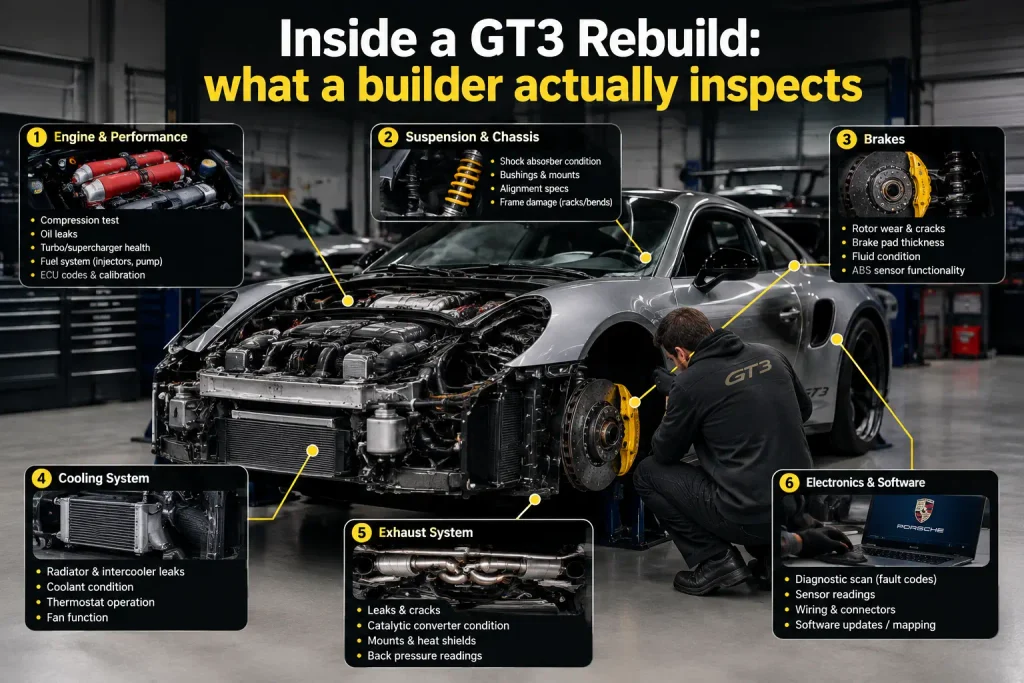
Crankshaft wear, scoring and over-rev damage
The crankshaft is the most expensive single component in the engine, and it is the one item where a builder’s judgement decides whether a rebuild costs five figures or ten.
Magnetic particle inspection comes first
The crank gets magnafluxed to reveal cracks, which concentrate at the fillet radii where the journals meet the webs. This is where a severe over-rev or a spun bearing leaves its evidence. A cracked crankshaft gets replaced, with no discussion and no repair attempt.
Journals get measured, not eyeballed
A micrometer reads each rod and main journal for diameter, taper and out-of-round at several points. Light scoring polishes out. Deep gouges, heavy scratches or blue-black discolouration from an oil starvation event do not, and a crank that has been heat-affected has lost hardness whether or not it measures correctly.
Runout gets checked on V-blocks or between centres
A crank that has been through a hydrolock or a severe detonation event can bend without breaking, and a bent crank destroys new bearings within hours.
Thrust surfaces get inspected
Endplay outside specification means the thrust bearing surfaces have worn, and that lets the whole rotating assembly move fore and aft under clutch load.
Most GT3 crankshafts that come out of well-maintained engines get polished and reused. The ones that do not are usually attached to a story the owner would rather not tell.
Connecting rods and rod bearings
Titanium rods are light, strong and expensive. Their bolts are the limiting item. Rod bolts stretch under load and they are designed to be torqued to yield, which means they are single-use fasteners. A builder replaces them every time the rods come off, without exception, and a quote that does not include new rod bolts is a quote to avoid.
Rods get checked for straightness and for big end bore roundness. A rod that has run a marginal bearing distorts its big end, and a distorted big end kills the next bearing too. Bolt holes get inspected for thread damage and the small end bushing gets measured against the wrist pin.
Rod bearings themselves tell a story when you read them. Uniform grey wear across the surface is normal ageing. Copper showing through means the overlay is gone. Scratching points at debris in the oil, which sends the builder looking for the source. Wear concentrated on one side points at a bent rod or a misaligned crank. Any bearing that has partially seized and smeared means the crank journal underneath it needs careful measurement.
Pistons and piston rings
Forged aluminium pistons in a high compression naturally aspirated engine last a long time, but they are consumable in a hard-used engine.
Crown inspection
The builder looks for detonation damage, which shows as a sandblasted or eroded texture around the crown edge, and for valve contact marks, which are clean crescent impressions. Erosion near the ring land is a warning about fuel quality or tuning rather than about the piston.
Skirt measurement
Pistons get measured perpendicular to the wrist pin axis near the bottom of the skirt. A collapsed or worn skirt increases piston to bore clearance, which produces cold piston slap and accelerated liner wear.
Ring groove measurement
A feeler gauge between the ring and the groove reveals vertical play. Worn grooves let the ring flutter instead of sealing, and no amount of new rings fixes a worn groove.
Ring end gap
New rings get gapped to the finished bore, not fitted out of the box. End gap that is too tight causes the ring ends to butt when hot, which scores the liner. Too loose and the ring never seals properly.
Wrist pins and circlips
Pins get measured for wear and ovality. Circlips are always replaced.
Cylinder and liner inspection
This is where the Mezger architecture rewards its owner.
Each liner is an individual component with a Nikasil bore, so a builder measures each one separately for diameter, taper and ovality against factory tolerance, and replaces only what needs replacing. A single damaged liner on a Mezger is a parts order. The equivalent damage to a Carrera Lokasil crankcase means sleeving the whole block or sourcing another case.
The inspection covers three things.
Coating integrity
Nikasil is a plated layer. If it has worn through or flaked in a patch, usually because of overheating, detonation or debris passing through, the liner is finished. No hone recovers a coating that is gone.
Geometry
Round is what matters. New rings are round, and a bore that has gone oval cannot be sealed by any ring, no matter how carefully it is gapped.
Surface finish
A Nikasil bore needs a specific crosshatch pattern and surface roughness for the rings to bed. Honing Nikasil requires the right stones and the right technique, which is why this work goes to a specialist rather than a general machine shop.
Do not confuse streaking with scoring on a freshly rebuilt engine. Ring coating transfers onto the bore during break-in and leaves vertical marks that look alarming through a borescope. They are cosmetic and they do not affect ring seals.

Meet Elio Mitri
With more than 20 years in automotive engineering and performance work, Elio Mitri has built his experience through years of hands-on work with Porsche and other high-performance vehicles. From classic 911s to modern performance platforms, his approach combines proven mechanical knowledge with today’s diagnostic technology.
At Emegatronic, every engine is treated with the same level of care and attention to detail. Whether you need to restore a classic Porsche, diagnose a complex engine problem, or rebuild a high-performance powerplant, Elio brings a methodical approach to every project.
For him, the goal is simple: understand the problem, find the real cause, and build the right solution.
The things people blame on the engine
Several faults get filed under “GT3 engine problems” when they are really peripheral.
- Water pump. The impeller on Porsche pumps of this era can shed material. A failed pump causes overheating, and overheating damages engines, so the pump gets replaced preventatively at engine-out service. The engine did not fail. The pump did.
- Rear main seal. Weeping happens, more often at higher mileage. It is a seal, the transmission has to come off to reach it, and that is the entire story. It became famous because of the 996 Carrera, not because of the GT3.
- Coil packs and plugs. Misfires on a GT3 are far more often ignition than mechanical. Check coils and plugs before you start theorising about valves. Porsche specifies plug replacement on a time interval as well as a mileage interval, and track cars go through them faster.
- Exhaust manifold studs. Salt-belt cars corrode studs until they snap. You get an exhaust leak and a broken stud that has to be extracted from an aluminium head, which is tedious, but it is not an engine failure.
- Motor and transmission mounts. Collapsed mounts transmit vibration and clunks that owners interpret as internal noise. Check them before you panic.
A realistic maintenance plan
Frequency here assumes real use. Adjust upward for track work, not downward for low mileage, because oil degrades with time and moisture as well as distance.
| Item | Interval | Why |
| Oil and filter | Annually, or every 5,000 miles, or after every two track weekends | Fuel dilution and moisture load the oil regardless of mileage |
| Cut the filter open | Every change | Catches debris that oil analysis does not report |
| Used oil analysis | Every change once past 50,000 miles | Bearing wear shows as a trend, not an event |
| Coolant pipe pinning and welding | Once, before track use | Eliminates the failure mode permanently |
| Air oil separator | At engine-out service, or at first symptom | Cheap part, expensive consequence |
| Chain tensioners | At first cold start rattle, or at engine-out service | Slack chains wear guides and risk jumped timing |
| VarioCam solenoid screen | Inspect at major service | Varnish blocks the oil path that drives cam timing |
| Water pump and thermostat | At engine-out service | Labour is already paid for |
| Spark plugs | Per Porsche’s time and mileage interval, sooner with track use | Ignition faults masquerade as mechanical faults |
| Oil lines, coolers and fittings | Every service and after any off | Dry sump systems have a lot of plumbing to lose oil from |
| Coolant | Per Porsche schedule | Corrosion inhibitors deplete on a timeline |
| Over-rev report | At every major service and before any sale | Free diagnostic, permanently recorded |
| Compression and leakdown | Every two to three years on tracked cars | Establishes a baseline you can compare against |
What to check before you buy
Work through this list with the seller. A genuine enthusiast owner will have most of it ready.
- Pull the over-rev report. Non-negotiable. A seller who refuses has told you something.
- Verify the coolant pipes. Welded and documented, or budget for the job.
- Leakdown on all six cylinders. You want consistency across cylinders more than any specific number.
- Listen to a genuine cold start. Ask the seller not to warm the car before you arrive. Chain rattle and smoke both hide behind a pre-warmed engine.
- Read the oil analysis history if the owner kept one. Its existence alone tells you what kind of owner you are dealing with.
- Check for open recall campaigns by VIN through a Porsche dealer. Verify compliance rather than assuming it.
- Inspect the underside for track damage. Skid plates, kerb strikes and a repainted floorpan all tell you about the car’s life.
- Confirm the engine is original to the car, or that a replacement was properly documented.
- Look for evidence of cool-down discipline. Heat-bluing on the exhaust, cooked wiring near the manifolds, and a driver who talks about shutting the car off hot are all data.
The honest summary
The GT3 flat six is one of the strongest engines Porsche has ever put in a road car, and the risk profile reflects that. You are not managing a design flaw the way M96 owners are. You are managing one specific assembly method that Porsche got wrong, one driver error that the engine cannot absorb, and a short list of wear items that any high-output naturally aspirated engine accumulates.
Weld the coolant pipes. Pull the over-rev report before you buy. Change the oil on a calendar, not an odometer. Cut the filter open and actually look at it. Let the engine cool down before you shut it off.
Do those five things and the engine will almost certainly outlast your interest in owning the car.
Frequently asked questions
Does the 997 GT3 have an IMS bearing problem?
No. The Mezger engine’s intermediate shaft does not use the sealed ball bearing that fails on Carrera, Boxster and Cayman M96 and M97 engines. IMS retrofit kits and IMS Solution products do not apply to it.
Does the GT3 suffer from bore scoring?
Not as a population failure. The GT3 uses individual Nikasil-coated liners rather than the Lokasil bores found in Carrera M96 and M97 blocks. Damaged liners can be replaced individually.
Is the M97.76 more reliable than the M97.77?
Both share the same architecture and the same failure list. The 3.8 in the 997.2 brought detail revisions and a higher output, but coolant pipes, over-revs and the AOS remain the items to watch on either.
Can these engines be rebuilt?
Yes, and that is a genuine advantage over the Carrera engines. The split case, replaceable liners and serviceable bearings mean a specialist can refresh the engine with factory and motorsport parts rather than condemning the block.
When does a GT3 M97 engine need a rebuild?
Mileage alone does not decide it. Four things do. Rising bearing metals across three consecutive oil analyses. Leakdown falling on one or more cylinders against your own earlier baseline. Metal in the filter that is larger than fine glitter. Or a specific event, meaning a severe over-rev, an overheat, a hydrolock or an oil pressure loss. A road-driven GT3 with none of those can pass 100,000 miles without the case being split. A car with several hundred track hours usually earns a bottom-end refresh somewhere between 60,000 and 100,000 miles, and that refresh is planned maintenance rather than repair.
What should be checked before rebuilding a GT3 M97 engine?
Establish why the engine is coming apart before you spend anything. Pull the over-rev report, run a full leakdown, borescope every cylinder, cut open the filter and drop the oil into a clean pan to look for debris. Send an oil sample so you know which metals are elevated. Confirm the oil pressure reading with a mechanical gauge rather than trusting the sender. Verify the engine’s identity and history, including whether it is original to the car. Then agree with your builder, in writing, what gets measured and what the decision criteria are for replacing the crankshaft, the liners, the rods and the heads. The difference between a good rebuild and a bad one is almost entirely in the measuring, and measuring is the part that is easiest to skip and hardest to see on an invoice.
Can an over-rev damage the GT3 M97 engine?
Yes, and the severity depends on which range it landed in. Ranges 1 and 2 are normal for a car driven hard and carry no meaningful risk. Range 3 is worth investigating. Ranges 4 through 6 mean engine speed went far enough past the limit that the valvetrain lost control of the valves. At that point you can get valve float, spring damage, bent valve stems, damaged seats and, at the extreme, valve-to-piston contact. The catch is that the engine often keeps running afterwards and the damage shows up months later as falling compression on one cylinder. Any severe over-rev deserves a leakdown test straight away, not a hope that it was fine.